USDT loses 2.5 points to USDC as total stablecoin supply hits $322B—what the shift means for your capital

Don't scroll Twitter for crypto news
One email. Five minutes. Everything that matters today
Stablecoin Market Dominance in 2026: $322B ATH and a Shifting Power Structure
The total stablecoin market capitalization hit $322 billion on April 16, 2026 – a new all-time high – as the sector's internal power structure quietly shifted. Stablecoin market dominance now stands at 13% of total crypto market cap, with Q1 2026 total stablecoin transaction volume reaching $28 trillion (a 51% year-over-year increase) and yield-bearing products now driving more than half of all new supply growth.
Track where stablecoin capital flows before the next market move. Web Snack covers ETF flows, on-chain metrics, and stablecoin trends daily – free, in under 5 minutes.
How USDC Gained on USDT Market Share: The Path to $322B
The $322B figure didn't appear overnight. Throughout early 2026, the stablecoin market set and reset its own records. On January 18, the total market cap stood at $311.3 billion – already a record – as observers noted a rotation into on-chain dollar assets during the equity sell-off. By March, the total crossed $320 billion.
Then, in a single week ending April 16, another $2.25 billion entered the market. Throughout Q1 2026, USDT's actual supply contracted by $3 billion, and Tether's market share slid from 60.46% to 57.96% – a 2.5-point decline. At the same time, USDC added $2 billion in Q1 alone and has grown 72% year-over-year, compared to USDT's 36% YoY growth. USDC now controls over 70% of all stablecoins on Solana.
This wasn't simply USDC gaining users. It reflects a structural reallocation in total stablecoin supply growth – institutional players and DeFi protocols increasingly choosing Circle's USDC for its regulatory positioning, even as Tether retains the largest raw market cap at $185.5 billion. Stablecoin market dominance within the USDC segment is rising precisely while the overall Tether share compresses.
USDT vs USDC: Q1 2026 Market Share Shift
Metric | USDT (Tether) | USDC (Circle) |
|---|---|---|
Market Cap (Apr 16, 2026) | $185.463B | $78.621B |
Market Share (Apr 16, 2026) | 57.96% | 24.6% |
YoY Growth | +36% | +72% |
Q1 2026 Supply Change | -$3B | +$2B |
Primary Chain | Tron | Ethereum |
Why Yield-Bearing Stablecoins Are the Fastest-Growing Segment in 2026
To understand the Q1 2026 supply growth, start with one subsector that barely existed two years ago: yield-bearing stablecoins. These instruments pay holders a return – similar to a savings account – by routing deposited dollars into Treasury bills or DeFi lending protocols.
In Q1 2026, yield-bearing stablecoins fueled more than 50% of the entire net stablecoin supply increase, and the sector grew 22% in the quarter. USDY, issued by Ondo Finance, rose over 150% during Q1. sUSDS – the yield-bearing version of Sky Dollar (USDS) – added $2.5 billion on its own.
The current yield-bearing stablecoin subsector is projected to triple to approximately $11 billion by end of 2026, up from an estimated $3.7 billion at Q1 close. Earlier waves of stablecoin demand were primarily transactional – traders parking dollars between positions, protocols using stablecoins as collateral. The Q1 2026 data shows a second demand type taking hold: users treating stablecoins as a yield instrument. That's capital with different retention characteristics than pure trading collateral.
What Happened to Solana Stablecoins After the Drift Exploit
On April 1, 2026, Drift Protocol – a Solana-based synthetic derivatives platform – was exploited for $285 million. Within six hours, $232 million in USDC moved from Solana to Ethereum across 100+ transactions. Circle, USDC's issuer, did not freeze those assets.
Tether responded with capital. The company provided a $127.5 million recovery package (plus $20 million from partners, totaling $147.5 million) structured as a revenue-linked credit facility. The deal moved 128,000+ users and 35+ Solana ecosystem teams from USDC onto USDT settlement rails.
The post-exploit picture is split. On April 21, USDT hit its own all-time high market cap of $188 billion, while USDC stood at $78.25 billion the same day. Yet on Solana specifically, USDC still controls over 70% of stablecoin supply – Circle's existing infrastructure held even after the Drift rescue. Zooming out: Ethereum holds $153.41 billion in stablecoin supply and Tron holds $83.47 billion, together accounting for 90% of all stablecoins in existence.
How Stablecoin Market Dominance Change Affects Retail Investors in 2026
The $322B total is useful context. What matters more is what the underlying dynamics actually mean.
USDT's 57.96% stablecoin market dominance – while declining – still means more than half of all stablecoins in circulation are Tether-issued. The Drift exploit put the two issuers' risk postures on display side by side: Circle let $232 million move in six hours without a freeze. Tether wrote a check. Those are different bets for anyone deciding which stablecoin to hold.
Then there's the bot activity data from Q1 2026. Of the $28 trillion in transaction volume, 76% was bot-driven – the highest share since Q2 2024, according to Gate's Q1 2026 report. USDC bots alone accounted for 85% of all bot activity. A large portion of the headline volume is automated: arbitrage, liquidations, MEV extraction. Not fresh capital.
At 13% of total crypto market cap and approximately 75% of all crypto trading volume, stablecoin supply now functions as a leading indicator for broader market liquidity. When total stablecoin supply growth accelerates, more capital is available to deploy into BTC, ETH, and altcoins. When it contracts – as it did in January 2026, when ERC-20 stablecoin supply on Ethereum fell $7 billion during a risk-off flush – altcoin liquidity feels it immediately.
Fastest-Growing Stablecoins in 2026: What to Monitor Next
Several confirmed developments will shape stablecoin market dominance through the rest of 2026.
The PARITY Act – the Proof of Solvency and Regulatory Transparency bill – was re-introduced in the US Congress on April 6, 2026. If passed, it addresses de minimis exemptions for stablecoin payments, removing one of the primary friction points blocking retail adoption for everyday transactions.
Drift Protocol's relaunch is the more immediate test. The question is simple: what percentage of Drift's recovered user assets settles in USDT versus USDC? That number will say more about Tether's Solana rescue than any press release. Meanwhile, the yield-bearing stablecoin subsector – USDY, sUSDS, and BUIDL (BlackRock's tokenized money market fund) – is on a projected path from $3.7 billion to $11 billion by December 2026.
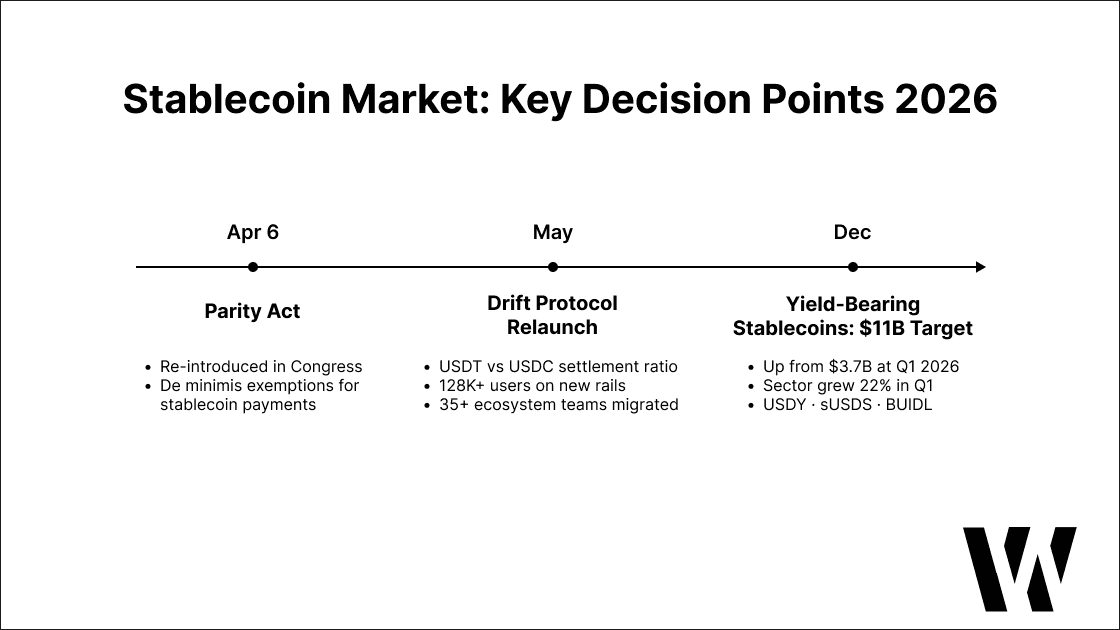
Three specific signals to watch:
Total stablecoin supply as a percentage of total crypto market cap – above 15% means capital is rotating defensive, not deploying into risk assets
Drift Protocol's USDT vs USDC settlement ratio at relaunch – the clearest read on whether Tether's intervention produced durable user retention
PARITY Act committee status in Congress – passage would remove the tax friction that has kept stablecoin payments marginal at the retail level
Stablecoin flows, yield data, and on-chain metrics show up in Web Snack every morning – free and takes under 5 minutes to read.
This article is for informational purposes only and does not constitute investment advice. Always conduct your own research before making any financial decisions.
Like this story? There's more tomorrow
Join Web Snack – no fluff, just value