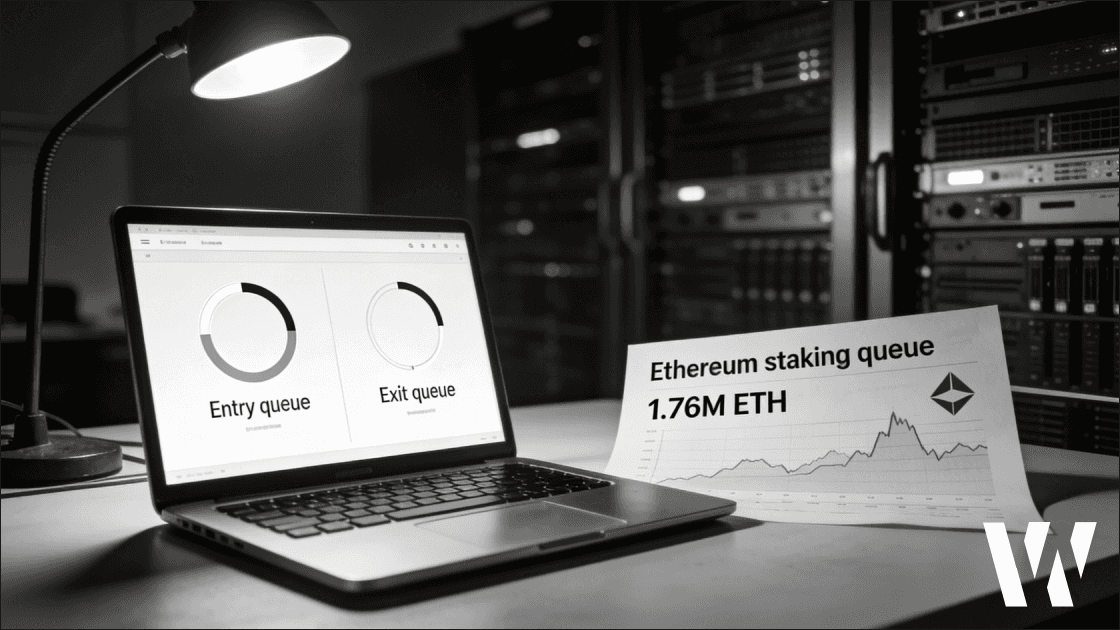
Ethereum staking queue hit ~1.76M ETH in January 2026 as the validator exit queue cleared, highlighting strong staking demand under churn limits.
Don't scroll Twitter for crypto news
One email. Five minutes. Everything that matters today
Ethereum Staking Queue Hits 1.76M ETH as Exits Clear – January 2026
Ethereum’s staking queue climbed to about 1.76 million ETH in early January 2026, while the validator exit queue cleared, according to tracking dashboards and market coverage. This matters because Ethereum has supported staking withdrawals since the Shanghai–Capella (“Shapella”) upgrade in 2023, so today’s bottleneck reflects demand and protocol limits, not a new withdrawals unlock.
Want a fast read on what actually moves crypto markets each day – flows, staking, majors, and the headlines that matter? Subscribe to Web Snack, a daily crypto market brief built for operators and investors.
Context
Ethereum enabled staking withdrawals as part of Shapella, which activated at epoch 194048 on April 12, 2023, after client teams scheduled the mainnet upgrade following Goerli testing. Ethereum’s staking withdrawals documentation confirms withdrawals became available on April 12, 2023, and explains that rewards above 32 ETH can be automatically paid out to a withdrawal address once credentials are set.
That backdrop makes the January 2026 data easier to interpret: exits can happen, but they are not dominating flows. Instead, Ethereum’s validator set changes through a safety mechanism that limits how quickly validators can enter and exit, which naturally creates a queue when inflows run ahead of capacity.
Details
A widely circulated snapshot put the Ethereum staking entry queue at 1.759 million ETH, commonly rounded to 1.76 million ETH, described as the largest backlog since August 2023. The same reports valued the queued ETH at about $5.5 billion and said new validators faced an activation wait of roughly 30 days and 14 hours, with the unstaking queue “completely empty.”
In parallel, reporting said Ethereum’s validator exit queue had “cleared,” ending a multi-month period when exits were delayed and operationally painful for staking protocols and leveraged strategies. Yahoo Finance also reported that the exit queue cleared while the entry queue remained large, framing it as a notable shift in staking flows at the time.
Expert quote (protocol scheduling): “It’s happening 🎊 Shapella is scheduled on mainnet for epoch 194048, scheduled for 22:27:35 UTC on Apr. 12, 2023 📆” – Tim Beiko, Protocol Support, Ethereum Foundation, Mar 28, 2023, via X (embedded in Cointelegraph).
Expert quote (market structure): “Liquid staking tokens … are now less likely to trade at a discount.” – Kirill Kutakov, Co-founder, StakeWise, Jan 7, 2026, quoted by DL News.
Impact
A large entry queue with a cleared exit queue suggests more ETH is trying to enter staking than leave it, at least during the January reporting window. The “why” is partly mechanical: DL News reported Ethereum’s exit queue exists for security and “limits the speed at which Ether can leave the network,” citing a current setting “around 57,600 tokens every day.”
For liquid staking and DeFi, reduced exit congestion can tighten liquid staking token pricing by lowering “duration risk,” and it can make leveraged staking strategies easier to unwind. Separately, Ethereum.org notes a proposer can include “up to 16 eligible withdrawals” in a block during sweeping, which helps frame why withdrawals and credential updates process continuously rather than all at once.
Next Steps
Two metrics matter most for operators and investors: the entry queue (how long new stake waits to activate) and the exit queue (how long stake waits to leave), since both are direct outputs of protocol guardrails plus user demand. If the entry queue stays elevated while exits remain light, it reinforces a “sticky stake” narrative; if exits rebuild, liquidity and risk premia can reprice quickly across liquid staking tokens and staking-linked leverage.
Finally, it’s worth keeping the timeline straight: staking withdrawals were enabled in April 2023, and Ethereum’s official documentation still points to that date, so claims of a new Shanghai–Capella mainnet activation in 2026 conflict with the canonical record.
If you want this kind of signal-first coverage every morning – what changed, why it matters, and what to watch next – join Web Snack. It’s a daily crypto newsletter with a clean market recap and actionable context.
P.S. This article is for informational purposes only and does not constitute investment advice. Always conduct your own research and make independent decisions.
Like this story? There's more tomorrow
Join Web Snack – no fluff, just value