NY Fed rate checks on USD/JPY sparked intervention chatter as DXY hit a 4-year low and gold topped $5,280 ahead of the Fed.
Don't scroll Twitter for crypto news
One email. Five minutes. Everything that matters today
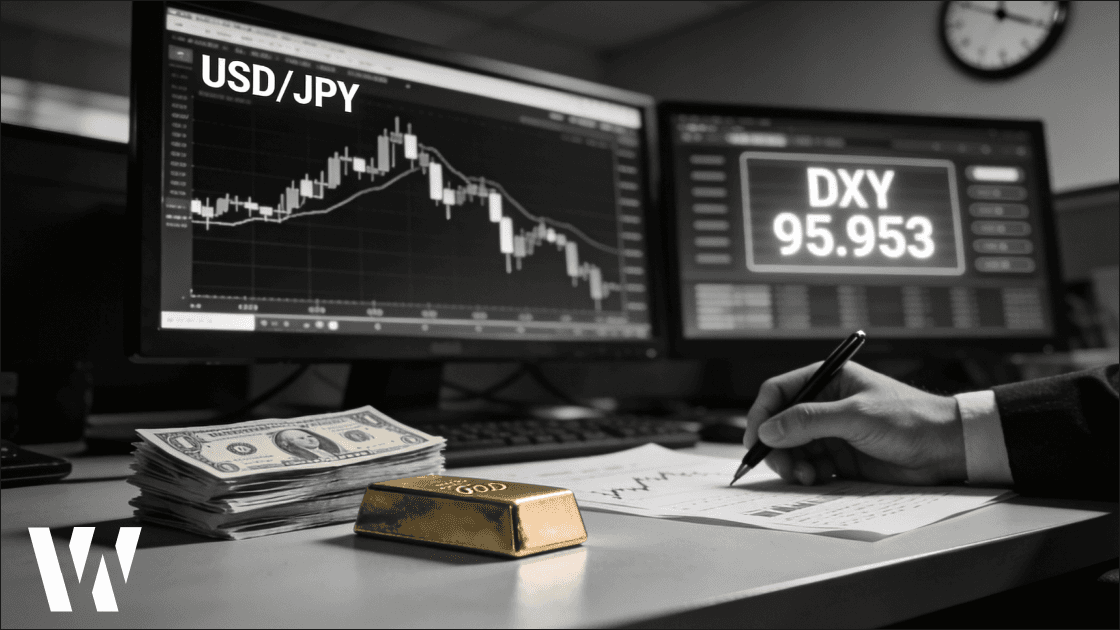
NY Fed Rate Checks Jolt USD/JPY as DXY Hits 4-Year Low – January 2026
A New York Fed “rate check” on USD/JPY on Jan. 23 triggered a sharp move in dollar/yen and intensified intervention speculation around Japan’s 160 level. In the following sessions, the broader dollar slid to a four-year low while gold hit records above $5,280/oz, and Japan’s BOJ-data-based estimates suggested no large-scale yen-buying intervention took place.
Context
The New York Fed conducted “rate checks” on the dollar/yen pair around midday Friday, Jan. 23, acting as fiscal agent for the US Treasury, according to Reuters reporting carried by multiple outlets.
Rate checks are typically described as dealers being asked for pricing quotes, a way for authorities to gauge liquidity and signal attention without necessarily executing trades. The market treated the move as a notable escalation because rate checks have historically preceded intervention activity.
Reading this is good.
Getting the full daily brief is better.
Join WebSnack.
Details
After the rate check, USD/JPY fell from around 157.60 to as low as 156.02 within roughly 1.5 hours, before trading down near the mid-155s in some prints.
Spectra Markets President Brent Donnelly called the signal unusual: “The Fed has asked for rates in USDJPY according to many reliable sources. This is USD bearish. Highly unusual. Strong signal.” – Brent Donnelly, President, Spectra Markets, Jan. 23, 2026.
Separately, the US Treasury and Japan’s Ministry of Finance have an agreed consultation framework. In their Sept. 11, 2025 joint statement, both sides reaffirmed that exchange rates should be market-determined and that FX intervention should be reserved for addressing “excess volatility and disorderly movements.”
Impact
Gold surged to a record above $5,280/oz, extending gains after a sharp jump in the prior session, as investors reacted to dollar weakness and a flight from sovereign bonds and currencies.
Standard Chartered’s Suki Cooper framed the driver mix as policy expectations and geopolitics: “Expectations of a more dovish and less independent Fed, as well as geopolitical risks, are likely driving more rapid allocations to gold, led by retail investors.” – Suki Cooper, Head of Global Commodities Research, Standard Chartered, Jan. 27, 2026.
US consumer sentiment also deteriorated sharply. The Conference Board said the Consumer Confidence Index fell 9.7 points in January to 84.5, and the Expectations Index dropped to 65.1 – below the 80 threshold that usually signals a recession ahead.
“Confidence collapsed in January, as consumer concerns about both the present situation and expectations for the future deepened,” said Dana M Peterson, Chief Economist at The Conference Board, Jan. 27, 2026.
Next Steps
Focus now shifts to the Federal Reserve’s Jan. 28 decision and Chair Jerome Powell’s press conference, scheduled for 2:00 pm ET (19:00 UTC) and 2:30 pm ET, respectively. Markets will be watching whether the Fed’s guidance reinforces or pushes back on the recent “weaker dollar” narrative.
Japan’s side of the story also got a key update. Market estimates based on BOJ current account deposit data suggested there was no large-scale yen-buying intervention on Jan. 23, implying the move reflected signaling (rate checks) and positioning rather than heavy reserve deployment.
That distinction matters for traders because a verified, sustained intervention campaign tends to reshape positioning differently than warnings and checks, even when headlines blur the two.
Want this kind of breakdown daily?
WebSnack sends one concise email every morning.
P.S. This article is for informational purposes only and does not constitute investment advice. Always conduct your own research and make independent decisions.
Like this story? There's more tomorrow
Join Web Snack – no fluff, just value