Testnet data shows post-quantum signatures cut Solana throughput 90%, revealing the tradeoff between quantum security and speed.
Don't scroll Twitter for crypto news
One email. Five minutes. Everything that matters today
Solana Post-Quantum Tests Reveal 90% Speed Drop in April 2026
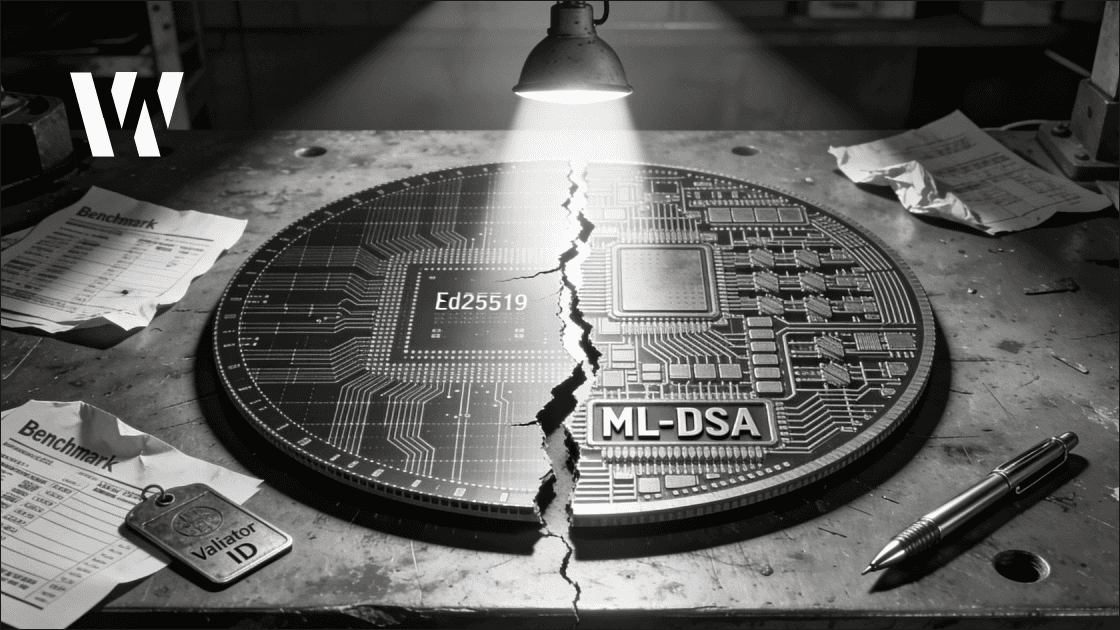
The Solana Foundation and Project Eleven released testnet data in April 2026 showing post-quantum signatures run 20 to 40 times larger than current ones, cutting network throughput by roughly 90%. The results reveal the cost of making the fastest major Layer 1 blockchain resistant to future quantum attacks.
Quantum upgrades will reshape how every blockchain handles security. Follow the Web Snack newsletter to track which protocols are actually shipping post-quantum changes.
Context
The Solana Foundation partnered with Project Eleven - a post-quantum security firm - in December 2025 to assess how the network would hold up against future quantum computers. Project Eleven deployed a live testnet replacing Solana's standard Ed25519 signatures with ML-DSA, a signature scheme standardized by NIST in August 2024 under FIPS 204. The testnet was open-sourced, making it the first publicly available post-quantum implementation for a high-throughput Layer 1.
Solana has a structural disadvantage compared to other major chains. Bitcoin and Ethereum derive wallet addresses from hashed public keys, adding a layer of protection before quantum computers become capable. Solana exposes public keys directly, meaning every wallet on the network is at risk the moment it transacts.
Project Eleven raised a $20 million Series A in January 2026 to expand its work across multiple blockchain ecosystems. The Solana collaboration remains its most technically detailed deployment to date.
Details
Testnet results show quantum-resistant signatures are 20 to 40 times larger than Ed25519's current 64-byte signatures. That size increase reduced network throughput by roughly 90% in the test environment. Solana's architecture - built around compact signatures and high transactions per second - is more sensitive to these size increases than slower chains.
"In Solana, 100% of the network is vulnerable," said Alex Pruden, CEO of Project Eleven. "A quantum computer could pick any wallet and immediately start trying to recover the private key."
Matt Sorg, VP of Technology at the Solana Foundation, described the work in an official blog post as a long-term commitment: "Our responsibility is to ensure Solana remains secure not just today, but decades into the future." Sorg added that Solana's culture of shipping - including the upcoming second client and Alpenglow consensus upgrade - supports continued security investment.
Impact
A 90% throughput reduction would make Solana's mainnet effectively unusable at current transaction volumes. Developers are looking at off-chain verification and hybrid deployment - running quantum-resistant signatures alongside existing ones - to manage the transition. One immediate complication: the upcoming Alpenglow consensus upgrade relies on BLS signature aggregation, and there is currently no post-quantum equivalent with comparable efficiency.
For users who want protection now, an optional Winternitz Vault has been available since January 2025. Introduced by Zeus Network chief scientist Dean Little, the vault uses Winternitz One-Time Signatures and generates a new cryptographic key for every transaction. It offers 224-bit quantum resistance via a truncated Keccak256 hash, but requires users to manually opt in - the broader network is unchanged.
The timing question is sharpening. A Google Quantum AI paper published March 30, 2026 estimated that breaking the secp256k1 elliptic curve could require as few as 1,200 logical qubits on certain architectures - closer to current hardware than most prior estimates. Ethereum co-founder Vitalik Buterin has cited a 20% probability that elliptic curve cryptography faces serious threats before 2030.
Next Steps
Project Eleven is continuing work with the Solana Foundation on performance optimization under quantum-resistant signatures. The goal is to find off-chain verification methods that absorb quantum-safe cryptography without the 90% throughput penalty seen in early tests.
No mainnet deployment date has been set. "This is a tomorrow problem - until it's today's problem," Pruden said. "And then it takes four years to fix." NIST's own migration guidance treats the transition as a decade-plus program and recommends hybrid schemes - classical and post-quantum algorithms running together - as an interim step.
Other chains are moving faster on hard timelines. Ripple published a four-phase XRP Ledger quantum roadmap on April 20, 2026, targeting full post-quantum cryptography by 2028. Ethereum's post-quantum team placed migration on its formal 2026 protocol roadmap. For Solana, the next concrete step is likely a second round of testnet benchmarks with performance optimization applied.
The performance tradeoff is just the beginning. Get the Web Snack newsletter for weekly breakdowns of the technical decisions shaping crypto's next era.
P.S. This article is for informational purposes only and does not constitute investment advice. Always conduct your own research and make independent decisions.
Like this story? There's more tomorrow
Join Web Snack – no fluff, just value