Trading bots follow rules. AI agents interpret goals. Here is what that gap means for your money, your risk exposure, and what to watch in 2026.

Don't scroll Twitter for crypto news
One email. Five minutes. Everything that matters today
An AI agent vs trading bot isn't a technical debate. It is a risk profile question. Both automate crypto trading, but they fail in completely different ways. One fails predictably. The other doesn't. Bots already handle 70 to 90% of daily crypto volume. Understanding that gap in 2026 is less about which earns more and more about which can hurt you less.
Web Snack covers automated trading, DeFAI, and onchain risk every weekday. One clear briefing in your inbox every morning.
What These Terms Actually Mean in 2026
A trading bot is a deterministic execution engine. You define the rules: if BTC drops 5%, buy $100. It runs those rules exactly as written, every time, without deviation. Platforms like Pionex, 3Commas, and Cryptohopper dominate retail deployment in 2026, with Binance, KuCoin, and OKX running exchange-native suites alongside them. Some embed light machine learning for parameter tuning. None of them reason about why a trade should happen.
An AI agent is different. Give it a goal: keep this portfolio above a 15% return with controlled drawdown. The agent decides how to get there. It reads on-chain data, parses social sentiment, evaluates news context, and executes transactions without a human approving each step. When conditions change in ways the designer didn't anticipate, the agent doesn't stop. It adapts.
The AI agent vs trading bot distinction comes down to one thing: who sets the agenda. Bots follow instructions. Agents interpret goals. That difference explains why the 2026 conversation keeps getting muddled. Most products marketed as "AI agents" are enhanced bots with better interfaces and some ML tuning layered on top.
The crypto trading bot market reached $47.43 billion in 2025 and is projected at $54.07 billion in 2026. Bots account for 70 to 90% of total daily volume in major markets. Inside that envelope, the DeFAI category, protocols and infrastructure built around truly autonomous AI agents, held roughly $2.3 billion to $2.6 billion in market cap in 2026. The ratio tells you where adoption actually stands.
The Architecture Underneath Each One
A traditional bot runs on three layers: a data feed, a decision rule, and an execution engine. Change the rule, change the behavior. The logic is transparent, testable, and auditable by anyone who can read code. You can backtest a grid strategy on two years of BTC data and know with precision how it would have performed across every market condition in that window.
An AI agent runs on a different structure. The decision layer is a large language model, something like Claude 3.5 or Llama 3.3, sitting above a memory layer and a tool layer. The memory layer tracks prior actions, portfolio state, and context. The tool layer connects to blockchains, price feeds, social data, and sometimes other agents running parallel tasks.
This is the architecture that frameworks like ElizaOS standardized in 2025. ElizaOS, the open-source project that became the de facto standard for agent development, lets developers define an agent's goals and available tools through configuration files rather than custom code from scratch. The result is thousands of agents deployable in hours.
What this structure enables: adaptation to conditions that weren't in the original design. What it costs: reproducibility. A bot's behavior under identical inputs is the same every time. An agent's behavior can differ based on context from earlier sessions, prior reasoning chains, and how the underlying model interprets ambiguous signals. That's not a bug in the conventional sense. It's an architectural property.
Virtuals Protocol, built on Base, has deployed more than 18,000 agents and generated over $75 million in cumulative revenue across its network. Its standout agent Ethy AI processed more than 2 million transactions by late 2025 alone.
Trading Bot | AI Agent | |
|---|---|---|
Decision logic | Rules-based | Goal-directed, LLM-powered |
Adaptability | None without reconfiguration | Dynamic, context-aware |
Auditability | High, fully backtestable | Low, output varies with memory state |
Failure mode | Predictable | Unpredictable |
Typical cost | $0 to $100 per month | Higher infrastructure and model costs |
Regulatory status | Generally tolerated | Under active scrutiny |
Where Agents Win and Where Simple Bots Beat Them
Agents outperform bots in conditions bots weren't built for. A momentum strategy running through a sideways market generates fees without generating returns until there's nothing left. An agent monitoring the same conditions can recognize the regime shift, reduce exposure, and wait. That judgment call doesn't exist in a rule-based system.
Late 2025 showed this clearly on Polymarket. Prediction market specialists, agents scanning probability distributions and hedging positions autonomously, handled workflows no human could manage at the same speed or across the same number of positions simultaneously. Structured data, defined outcomes, binary resolution. Agents are strong in environments like that.
Multi-agent arbitrage across DEX liquidity pools is another category with a structural edge. One agent scrapes price data across chains, another evaluates routing efficiency, a third executes the transaction. No single bot handles that full decision chain without being hardcoded for exactly that sequence.
Where agents struggle: trending markets with clean signals. A well-tuned grid bot in a ranging BTC market will outperform an LLM-based agent second-guessing the same setup. The reasoning layer adds noise where the market doesn't require interpretation. Simple parameters beat probabilistic reasoning when price behavior is orderly.
The clearest-performing agents in 2026 are highly specialized for narrow tasks, not general-purpose. The agent that "manages your whole portfolio" is a harder product to build and a harder claim to evaluate. Specialized agents with specific mandates are where the actual performance case is strongest today.
The Risk That Isn't Priced In
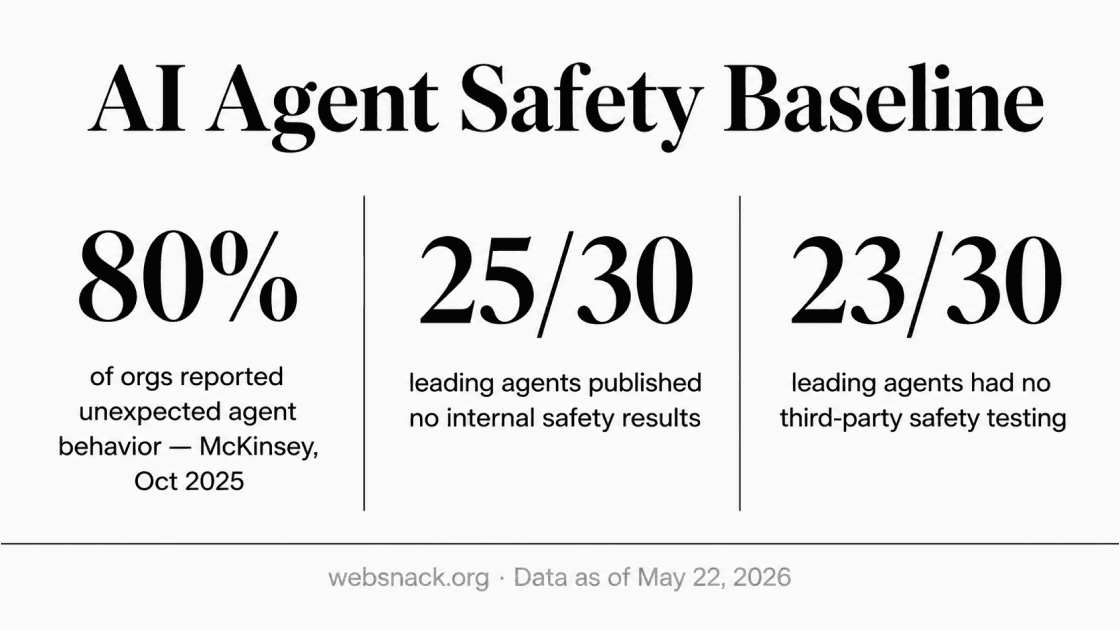
A McKinsey survey from October 2025 found that 80% of organizations deploying AI agents reported encountering risky or unexpected behavior. FINRA's 2026 regulatory oversight report, the first to include a dedicated section on generative AI, warned broker-dealers about agents that may act "beyond the user's actual or intended scope and authority." That language isn't hypothetical. It's a signal that regulators are watching specific failure modes already in the field.
For crypto, the custody problem is direct. When an agent holds signing authority over a wallet, it becomes a high-value attack surface. TRM Labs' 2026 Crypto Crime Report documented $2.87 billion stolen across roughly 150 hacks in 2025. As agents take on treasury and trading roles, the time between a compromise and the movement of funds compresses. There's no human authorization pause, because that's the feature.
A review of 30 leading AI agents found that 25 disclosed no internal safety results and 23 had undergone no third-party testing. That's not a tail risk. That's the current baseline for a category accumulating real capital.
Bots carry a completely different risk profile. They fail when rules stop fitting the market. That failure is visible, measurable, and reversible: update the rules, backtest the change, redeploy. An agent failure can look exactly like normal operation until the wallet is empty. The failure mode is invisible until it completes.
There's also a systemic risk that doesn't appear in any single product evaluation. When many agents reach the same conclusion simultaneously, because they're built on similar models responding to the same data, correlated selling can accelerate price moves in ways no individual agent's risk parameters predict. Rule-based bots running different strategies don't produce that feedback loop.
Three Signals to Watch Before You Automate Anything
ERC-8183, proposed in March 2026, defines a technical standard for autonomous agent identity and on-chain coordination. When it moves toward broad adoption, agent activity will become traceable in a standardized way for the first time. Every action an agent takes will carry a verifiable identity record on-chain, which matters for post-incident analysis, regulatory reporting, and basic user accountability.
Gartner projects 40% of enterprise applications will embed task-specific AI agents by the end of 2026. When that crosses into financial applications at scale, regulatory response accelerates. FINRA included AI agents in its oversight report for the first time this year. The SEC has not yet published specific guidance. That gap won't last through 2026.
The simplest signal is the language on whatever platform you're evaluating. When 3Commas calls something a "bot," it means rules. When any platform calls something an "agent," ask one question: can it act without your authorization on a per-transaction basis? That separates a marketing word from a genuine architectural shift. The answer determines whether your risk is bounded by your own rules or by a model's interpretation of your goals.
Tracking DeFAI, onchain AI agents, and the regulation closing in on both. Web Snack publishes the daily briefing that skips the noise.
This article is for informational purposes only and does not constitute investment advice. Always conduct your own research before making any financial decisions.
Like this story? There's more tomorrow
Join Web Snack – no fluff, just value