Three staking architectures, three risk profiles, three fee structures. This breakdown shows which one fits your portfolio size and custody preference in 2026.
Don't scroll Twitter for crypto news
One email. Five minutes. Everything that matters today
Crypto staking in 2026 runs on three architectures: custodial exchange staking, DeFi liquid staking, and hardware wallet self-custody. Each concentrates risk in a different place and charges a different fee structure. The right choice depends on one question: which failure mode is least acceptable for the position size and technical capacity of the holder?
Staking on Kraken vs Lido vs Ledger? The commission math tells a different story than the headline APY. Subscribe for the weekly breakdown.
Why Net APY Is the Only Staking Number That Matters
Headline APY is marketing. Net APY is what reaches the account.
Every staking architecture charges a fee somewhere in the stack. Exchange platforms take 25% to 40% of gross rewards as commission before crediting the balance. DeFi liquid staking protocols charge 10% to 15% of rewards as a protocol fee. Hardware wallet staking through direct validator delegation has no platform fee. The holder pays only the validator's own commission, which typically runs 5% to 10%.
On a 3.5% gross ETH yield, a 35% exchange commission produces a net return of 2.28%. A 10% DeFi protocol fee produces 3.15%. Hardware wallet native delegation at a 10% validator commission produces the same 3.15%, with no exchange counterparty exposure in the structure. The formula: Net APY = Gross APY multiplied by (1 - commission rate). Apply it before any deposit.
Headline rates shift weekly. The commission structure is what determines how much actually compounds.
How Exchange Staking Works and What It Costs
Exchange staking is custodial by design. When ETH or SOL goes onto Kraken or Coinbase, the platform holds the private keys, selects and operates the validators, absorbs slashing penalties, and handles tax reporting. No external wallet required. No validator selection needed.
Kraken charges 26% on bonded stakes and 30% on flexible staking, producing a net ETH APY of approximately 2.37% to 2.6% at current network rates. Coinbase's standard commission is 35%, with a reduced rate for Coinbase One subscribers. The commission gap matters at scale: on a $100,000 ETH position at 3.5% gross yield, the 8.6-percentage-point difference between Kraken's bonded rate and Coinbase's standard rate is worth roughly $300 per year in net returns.
The other cost is counterparty exposure. Exchange staking means the platform controls access to staked assets. FTX's 2022 collapse locked an estimated $8 billion in user assets. Celsius and BlockFi froze withdrawals the same year. Exchange crime insurance covers cold-storage theft. It does not respond to regulatory freezes, insolvency, or situations where the exchange is legally blocked from releasing funds. Kraken holds ISO/IEC 27001:2022 information security certification and publishes verifiable proof-of-reserves. Coinbase carries the most established US regulatory footprint in the exchange staking market. A March 17, 2026 SEC ruling removed legal ambiguity for exchange staking products on 16 named assets including ETH, SOL, ADA, and DOT, which expands what US platforms can offer without securities-law uncertainty.
DeFi Liquid Staking in 2026: Lido, Rocket Pool, and Jito
DeFi liquid staking removes the exchange custody layer. Depositing ETH into Lido returns stETH, a token that represents the staked position and accrues consensus rewards daily through an automatic rebase mechanism. StETH is tradeable and composable: deployable as collateral on Aave, traded on Curve, or held passively while the underlying ETH continues earning validator rewards. Rocket Pool issues rETH instead, which appreciates in value relative to ETH as rewards accumulate rather than adjusting the token balance.
Lido holds approximately 9.2 million ETH as of early 2026, representing 24.2% of all staked Ethereum. Its gross ETH APR runs approximately 2.4%, netting around 2.16% after Lido's 10% protocol fee on rewards. Rocket Pool distributes stake across over 2,500 independent node operators rather than a curated professional set, which produces a more decentralized validator architecture. Its net APR falls between 2.4% and 3.5% depending on network conditions.
Jito operates at a different yield level. JitoSOL is the liquid staking token for Solana that captures MEV (maximal extractable value - money validators earn from transaction ordering, redistributed to stakers through Jito's fee mechanism) on top of standard network rewards. That produces approximately 5.80% APY in 2026. The premium over standard Solana native staking is 0.5% to 1%. JitoSOL is composable across Solana DeFi, where it can serve as collateral on Kamino Finance or MarginFi while base staking yield accrues. Jito-client validators now control the majority of staked SOL by count.
Platform | Asset | Net APY (May 2026) | Custody Model |
|---|---|---|---|
Kraken (bonded) | ETH | 2.37-2.6% | CEX, platform holds keys |
Coinbase (standard) | ETH | ~2.28% | CEX, platform holds keys |
Lido | ETH | ~2.16% | Smart contract, non-custodial |
Rocket Pool | ETH | 2.4-3.5% (variable) | Smart contract, non-custodial |
Jito | SOL | ~5.80% | Smart contract, non-custodial |
Ledger/Trezor (native) | ETH, SOL, ADA | ~3.15% net (ETH) | Device, self-custody |
Smart contract risk is the structural trade-off on the DeFi side. Lido's 24.2% share of staked ETH creates concentration at the network level: a Lido protocol failure would affect Ethereum finality broadly, not just individual staker balances. Lido and Rocket Pool run insurance mechanisms for slashing events. Neither covers a catastrophic smart contract exploit.
Hardware Wallet Staking: Full Custody, No Platform Commission
Hardware wallet staking keeps private keys on a physically isolated device. The Ledger Flex ($249, CC EAL6+ certified Secure Element) and Trezor Safe 5 ($129, EAL6+, open-source firmware auditable on GitHub) are the two leading options in 2026. Both devices sign transactions on the secure element chip and require physical confirmation before anything executes.
Ledger Live supports native staking for ETH, SOL, ADA, DOT, and over 14 proof-of-stake assets through its companion app. Trezor Suite supports 7 assets natively, with ETH staking powered by Everstake. At a 3.5% gross ETH network rate and a typical 10% validator commission, hardware wallet native delegation nets approximately 3.15%. That is above both Kraken's 2.37-2.6% and Lido's 2.16%.
A lost 24-word seed phrase has no recovery path. No support ticket, governance vote, or protocol upgrade restores access. Phishing attacks that replicate fake Ledger Live firmware prompts remain active in 2026. Stakers managing ETH, SOL, and ADA simultaneously face operational complexity that scales with portfolio breadth. For positions above $50,000, the dollar value of exchange counterparty risk makes the device cost proportional. Below that number, the decision turns on how comfortable the holder is with seed phrase management.
Which Staking Path Fits Your Profile
Beginners who want managed custody should start with exchange staking on Kraken or Coinbase. Kraken's bonded ETH at 2.37-2.6% net handles validator selection, slashing coverage, and tax export. Coinbase's regulatory standing is the stronger choice for US holders who need 1099-MISC documentation at year-end. The commission is the explicit cost of the managed service, not a hidden fee. The non-negotiable constraint for this group: do not concentrate more than a prudent fraction of total portfolio value at any single exchange.
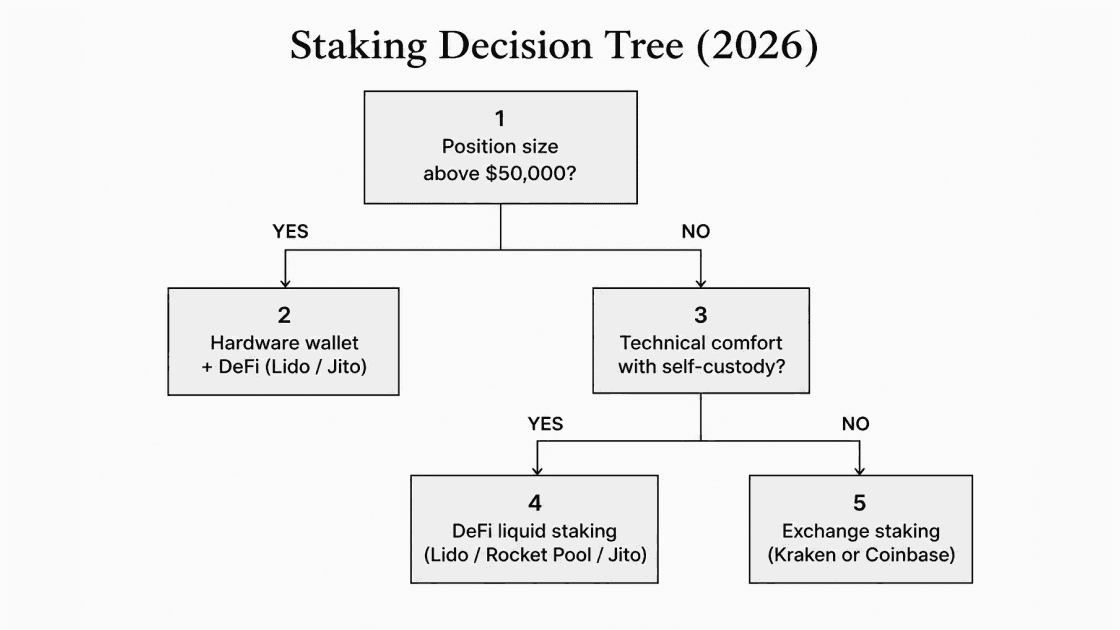
Intermediate holders comfortable with non-custodial wallets get structurally better net yields through DeFi liquid staking. For ETH, Lido at 2.16% net provides the deepest stETH liquidity and composability across lending protocols. Rocket Pool at 2.4-3.5% net offers a more decentralized validator architecture, which matters for holders concerned about Lido's 24.2% concentration in staked ETH. For SOL, Jito at 5.80% APY is the only major non-custodial option on any large PoS network in 2026 that captures MEV revenue at scale.
Holders above $50,000 in staked assets should add hardware wallet custody as a base layer paired with DeFi protocol access. EigenLayer holds $15.26 billion in TVL with 4.36 million ETH in restaking frameworks, opening an additional yield layer for self-custody holders willing to accept layered slashing exposure. That decision deserves separate analysis before any capital moves. The Rocket Pool Saturn I upgrade, expanding permissionless node operation through a lower-bond MEGAPOOL design, is the ETH liquid staking development most likely to shift protocol rankings before year-end 2026.
Which platform is eating the most of your staking yield? Calculate net APY on your current rate and subscribe to track the weekly changes.
This article is for informational purposes only and does not constitute investment advice. Always conduct your own research before making any financial decisions.
Like this story? There's more tomorrow
Join Web Snack – no fluff, just value