Bitcoin ETFs absorbed 19,000 BTC in nine days while miners produced 4,050. What the flow data means, what it doesn't predict, and how to read it

Don't scroll Twitter for crypto news
One email. Five minutes. Everything that matters today
"Bitcoin ETF flows explained" isn't a complicated concept, but it's a routinely misread one. The daily net flow figure is how much capital entered or exited U.S. spot funds on a given session. It has become the most-watched number in crypto markets. Spot Bitcoin ETFs now hold over 1.3 million BTC across 12 U.S.-listed funds, and what those numbers mean mechanically matters more than any daily headline.
Bitcoin ETF data is published every trading day. Subscribe to Web Snack for weekly breakdowns of what the institutional flow numbers actually show.
Why Bitcoin ETF Flow Data Became the Market's Most-Watched Number
Spot Bitcoin ETFs launched in the United States on January 11, 2024, giving institutional capital a regulated wrapper to hold Bitcoin without managing private keys. In their first two years, the 12 U.S.-listed funds accumulated $58.72 billion in cumulative net inflows. Gold ETFs took over a decade to reach comparable scale. Eric Balchunas, Senior ETF Analyst at Bloomberg Intelligence, put it directly: "Gold took over a decade to hit that number. U.S. Bitcoin ETFs are now just shy of gold, and we think they could triple gold ETFs in the next 3 to 5 years."
The data is published each trading day by Farside Investors, SoSoValue, and CoinGlass. Institutional allocators treat it as the primary gauge of how quickly the asset class is absorbing new capital. Four sources cover it in the U.S. market: Farside gives raw daily figures going back to launch; SoSoValue provides a fund-by-fund visual dashboard; CoinGlass combines flows across crypto ETFs; Bloomberg Terminal carries the most granular data, though it's inaccessible to most retail investors.
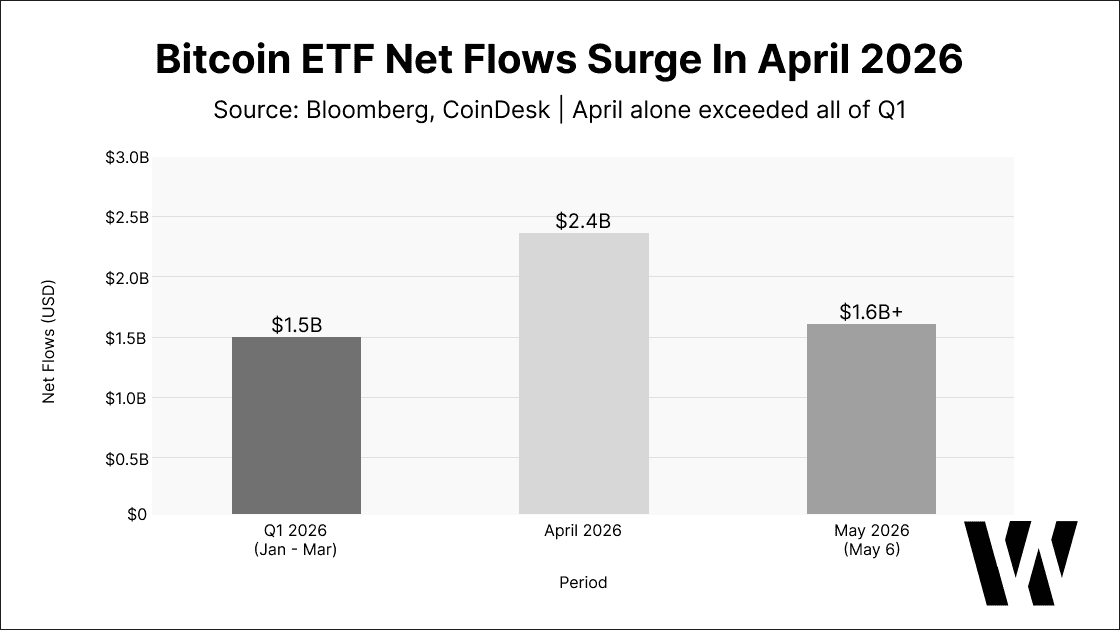
By April 2026, combined AUM across all U.S. spot Bitcoin ETFs had crossed $100 billion. April recorded approximately $2.4 billion in net inflows, the strongest single month since October 2025, when Bitcoin hit its all-time high of $126,000. January through March 2026 combined for approximately $1.5 billion in cumulative net inflows. April alone exceeded that figure by more than 60%.
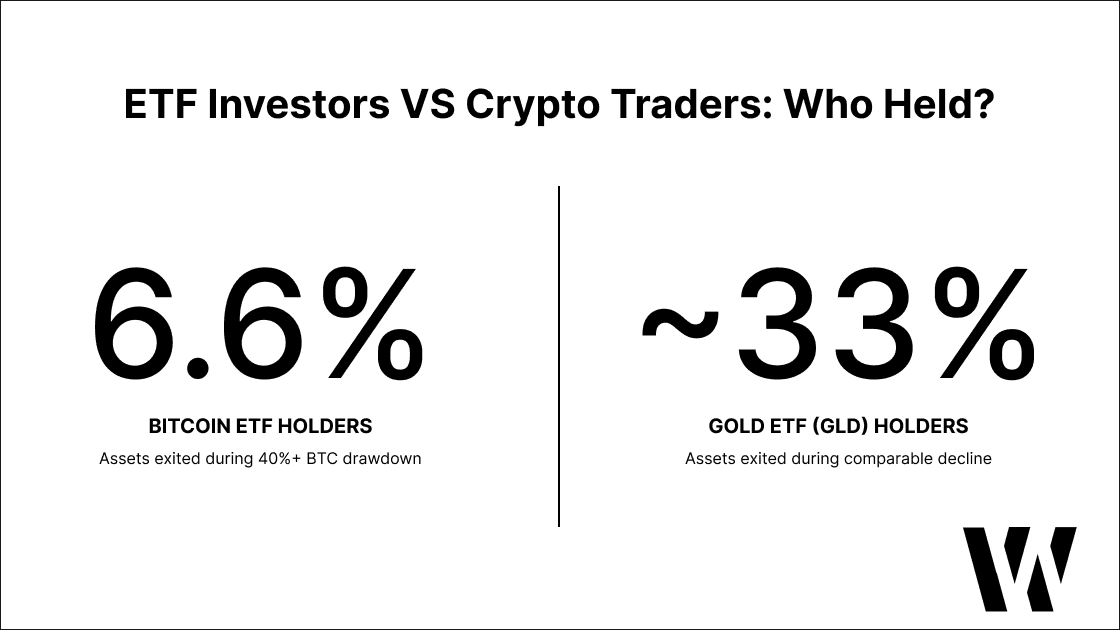
ETF investors behave differently from crypto-native traders, and the difference changes how the data reads. Many treat Bitcoin as a 1–2% portfolio allocation alongside equities and bonds. In the more than 40% decline from Bitcoin's October 2025 peak, only 6.6% of ETF BTC holdings exited. Gold ETF GLD shed about one-third of assets during a comparable decline roughly a decade ago.
How Bitcoin ETF Creation and Redemption Work
Spot Bitcoin ETFs operate through a creation and redemption mechanism managed by authorized participants (APs), which are large institutional market makers. When net inflows occur, APs deliver Bitcoin to the ETF issuer in exchange for newly created shares. When net outflows occur, APs return shares to the issuer and receive Bitcoin back. Individual retail investors never touch this process; they buy and sell shares on a stock exchange exactly like any other ETF.
From January 2024 through July 2025, all U.S. spot Bitcoin ETFs ran on a cash-only model. APs had to sell Bitcoin immediately on any redemption and hand the cash back to investors. That added friction and reduced arbitrage efficiency. The SEC approved in-kind creations and redemptions on July 29, 2025. APs can now deliver actual BTC instead of cash, which tightened arbitrage between ETF share price and spot BTC, cut transaction costs, and improved price tracking.
One structural difference separates spot ETFs from futures-based Bitcoin products. Futures ETFs held no physical Bitcoin; their flows had zero impact on spot supply. Spot ETFs must acquire actual BTC for every net inflow dollar. When consecutive days of net inflows absorb Bitcoin at multiples of the daily mining rate, the supply compression is real.
The daily net flow number reflects the difference between creation and redemption activity across all 12 funds. On May 1, 2026, $629 million in net inflows meant APs sourced approximately 7,800 BTC at an $80,000 average price and delivered it into ETF custody. That Bitcoin does not return to the open market unless a future redemption triggers its release.
IBIT, FBTC, and GBTC: Reading the Flow Divergence
BlackRock's IBIT has accumulated over $60 billion in cumulative net inflows since launch. In April 2026, it captured approximately 70% of the month's total flows. Fidelity's FBTC is the second-largest fund, recording $213.4 million in April 2026 inflows. Together, the two funds drive roughly 80% of cumulative net inflows across the entire category.
IBIT's dominance has structural roots. BlackRock's distribution network reaches the majority of U.S. registered investment advisors, pension funds, and wirehouses. Its name signals regulatory reliability to allocators who wouldn't access the same product from a smaller issuer. Fidelity's FBTC draws a different audience: wealth platforms that already use Fidelity custody, and retail investors who recognize the name. The flows reflect distribution infrastructure as much as product quality.
Grayscale's GBTC tells the inverse story. GBTC converted from a closed-end trust to an ETF in January 2024. Investors locked in since 2013 could suddenly redeem their shares. The fund has since recorded approximately $26 billion in cumulative net outflows. The driver is straightforward: GBTC charges 1.50% annually, while IBIT and FBTC charge 0.25%. Investors rotated into cheaper products.
Fund | Ticker | Annual Fee | Notable Data |
|---|---|---|---|
BlackRock iShares Bitcoin Trust | IBIT | 0.25% | ~$60B+ cumul. net inflows; ~810,000 BTC held |
Fidelity Wise Origin Bitcoin Fund | FBTC | 0.25% | No. 2 by flows; proprietary Fidelity custody |
ARK 21Shares | ARKB | 0.21% | Mid-tier AUM |
Bitwise Bitcoin ETF | BITB | 0.20% | Mid-tier AUM |
Morgan Stanley Bitcoin Trust | MSBT | 0.14% | Launched April 8, 2026; lowest fee in market |
Grayscale Bitcoin Mini Trust | BTC | 0.15% | Lowest permanent fee before MSBT launch |
VanEck HODL | HODL | 0.00%* | *Waiver expires July 31, 2026; reverts to 0.20% |
Grayscale Bitcoin Trust | GBTC | 1.50% | ~$26B cumul. net outflows since conversion |
By Q1 2026, GBTC's outflow rate had stabilized to approximately $1.2 billion for the quarter. That is down sharply from multi-billion-dollar quarterly outflows in 2024. The remaining holders are either comfortable with the higher fee or sitting on large unrealized gains that create tax-driven switching costs.
What Bitcoin ETF Inflows Don't Predict
Bitcoin ETF inflows do not predict price movements. Both flows and price respond to the same underlying catalyst: an improving risk environment, a macro shift, a regulatory development. The ETF buying then amplifies the move by removing supply from the open market. The flows are a consequence and an accelerant, not the cause.
The March 2026 inflow streak illustrates the pattern. Over seven trading days beginning March 9, Bitcoin rose from approximately $67,000 to $74,000. Both price and inflows were responding to fading geopolitical risk and improved risk appetite. The inflows reduced available supply while the rally was happening. That extended the move; it did not cause it.
IBIT's dollar AUM fell significantly from its October 2025 peak. Bitcoin's price dropped more than 40%; investor exits account for only 6.6% of BTC holdings over the same period. Analysts tracking AUM draw a very different picture from analysts tracking BTC counts directly. "A selloff doesn't mean the end. It just means it's a selloff," Balchunas said in February 2026.
Single-day flow figures are especially noisy. On May 7, 2026, a $268 million net outflow broke a nine-day inflow streak, with FBTC leading at $129 million and IBIT at $98 million. Bitcoin held near $80,000 throughout. The outflow reflected post-FOMC repositioning after the April 29 rate decision, not a structural shift in conviction.
Four Signals Worth Tracking in Bitcoin ETF Flow Data
The most informative flow data is not the daily headline. It is multi-day patterns measured against other variables. Four signals have demonstrated consistent value since spot ETFs launched.
Extended inflow streaks matter. Seven consecutive inflow days or more have preceded positive BTC returns over the following two to four weeks in most historical instances. The nine-day streak ending in early May 2026 totaled $2.7 billion, the strongest run since October 2025. That sustained pattern carries more signal than any individual session within it.
The absorption ratio against mining supply is the second signal. Bitcoin's post-halving daily output sits at approximately 450 BTC. When ETF net inflows exceed that rate across multiple consecutive sessions, supply compression builds independent of retail sentiment. The April 2026 nine-day streak absorbed roughly 19,000 BTC against approximately 4,050 BTC produced by miners over the same period.
Third: BTC holdings, not dollar AUM. Tracking the BTC count each fund holds removes the price distortion from dollar-denominated figures. IBIT held approximately 810,000 BTC as of early May 2026. It accumulated those holdings through more than a 40% price decline from the October 2025 high. That number tells a fundamentally different story from AUM.
Fourth: GBTC's outflow rate. Grayscale's structural selling was a persistent price headwind throughout 2024. Outflows have now stabilized at approximately $1.2 billion per quarter. A return to elevated GBTC outflows would signal renewed forced supply entering the market.
The Senate floor vote on Kevin Warsh's Fed chairmanship and the CLARITY Act committee markup are both expected during the week of May 11, 2026. Both events directly shape the regulatory environment Bitcoin ETF capital allocates into for the rest of the year.
ETF flows are the institutional signal most retail investors don't track week to week. Web Snack covers what the data shows, every week.
This article is for informational purposes only and does not constitute investment advice. Always conduct your own research before making any financial decisions.
Like this story? There's more tomorrow
Join Web Snack – no fluff, just value