Bitcoin ETFs, BlackRock's 1-2% allocation framework, and the drawdown math most coverage skips - what the decade of data actually shows for portfolio investors

Don't scroll Twitter for crypto news
One email. Five minutes. Everything that matters today
Bitcoin ETFs from BlackRock and Fidelity now trade on major US exchanges. State pension funds have held them. The world's largest asset manager recommends a 1% to 2% portfolio allocation. Crypto investing for traditional investors is no longer a niche question. It's a portfolio decision that demands the same analytical framework you'd apply to any other asset class.
Bitcoin is now accessible through your existing brokerage. The allocation math is more specific than most coverage suggests. Web Snack tracks institutional crypto flows for traditional investors, weekly.
Why Crypto Has Moved From Speculation to Allocation Decision
In January 2024, the SEC approved spot Bitcoin ETFs. The decision mattered less for what it said about Bitcoin and more for what it said about access. BlackRock's IBIT and Fidelity's FBTC began trading on January 11, 2024, accessible through any standard brokerage account and eligible for inclusion in IRAs. That friction is gone. No wallets, no private keys, no unregulated exchanges.
Institutional adoption followed quickly. By April 2025, spot Bitcoin ETFs had accumulated $65 billion in assets under management globally. BlackRock's IBIT alone held $55 billion as of March 2026, making it larger than most fixed-income ETFs launched in the past decade. Within their first year, US spot Bitcoin ETPs attracted $35.66 billion in net flows, surpassing the first-year record of gold ETFs when they launched in 2004.
The pension fund data is hard to ignore. The State of Wisconsin Investment Board was the first US state pension fund to disclose Bitcoin ETF holdings, buying $164 million in early 2024 before expanding to $321 million by February 2025. Michigan's State Retirement System holds Bitcoin ETF positions as of mid-2025. Pending legislation in Arizona, Louisiana, Missouri, Ohio, Oklahoma, and Florida would direct state retirement systems to evaluate crypto allocations. A 2025 survey by Coinbase and EY-Parthenon found 59% of institutional investors planned to allocate over 5% of AUM to digital assets that year.
This is not a 2017 retail frenzy. It's a structural shift in who owns the asset.
Bitcoin's Return Record: What a Decade of Data Shows
Bitcoin was the best-performing major asset class in 8 of the 11 years between 2014 and 2024, according to BlackRock and Bloomberg calculations. Over that full period, it averaged a 54% annualized return. A $100 investment in 2014 was worth $26,930 by 2024. The comparison to traditional assets across the same decade is not close.
Asset | Total Return (2014-2024) | Annualized Return | Annualized Volatility |
|---|---|---|---|
Bitcoin | 26,931% | ~54% | ~54% |
S&P 500 | 193% | ~14% | ~10.5% |
Gold | 126% | ~1.5% | ~15.1% |
10-year Treasuries | 87% | ~3.5% | Low |
Sources: CoinGecko; BlackRock; Fidelity Digital Assets
Bitcoin was also the worst-performing asset in the other three of those 11 years. That pattern defines the asset. Bitcoin only finishes first or last.
An investor who held through all three down years captured the full upside. Most investors did not.
The risk-adjusted numbers complicate the volatility story. Bitcoin's Sharpe ratio from 2020 to early 2024 was 0.96, versus 0.65 for the S&P 500 over the same period, according to Fidelity Digital Assets. Higher absolute volatility, but more return per unit of risk taken.
The Correlation Problem: Bitcoin Is Not the Hedge You Think It Is
The standard pitch for Bitcoin in 2018 to 2020 was portfolio diversification. Bitcoin had near-zero correlation with stocks and bonds. Adding it to a 60/40 portfolio reduced overall volatility while introducing a return source driven by different factors.
That pitch was accurate then. It is not now.
Bitcoin's correlation with the S&P 500 now ranges from 0.5 to 0.88 depending on timeframe, according to State Street and Bloomberg data as of August 2025. Gold's correlation with the same index sits at roughly 0.01. When equity markets sold off in 2022, Bitcoin didn't hold up. It fell 77.6% while the S&P 500 dropped roughly 25%.
This changes the investment case. It does not end it.
BlackRock's December 2024 analysis puts adoption at the center of the long-term return case. As Bitcoin becomes more widely held, that adoption demand drives prices independently of what equities do. The correlation convergence is a short-term market behavior pattern, not a structural link.
The honest framing: Bitcoin is a high-risk growth asset with an asymmetric return profile. Gold's near-zero correlation with stocks still holds. Bitcoin's does not.
How to Size a Crypto Allocation Without Blowing Up Your Portfolio
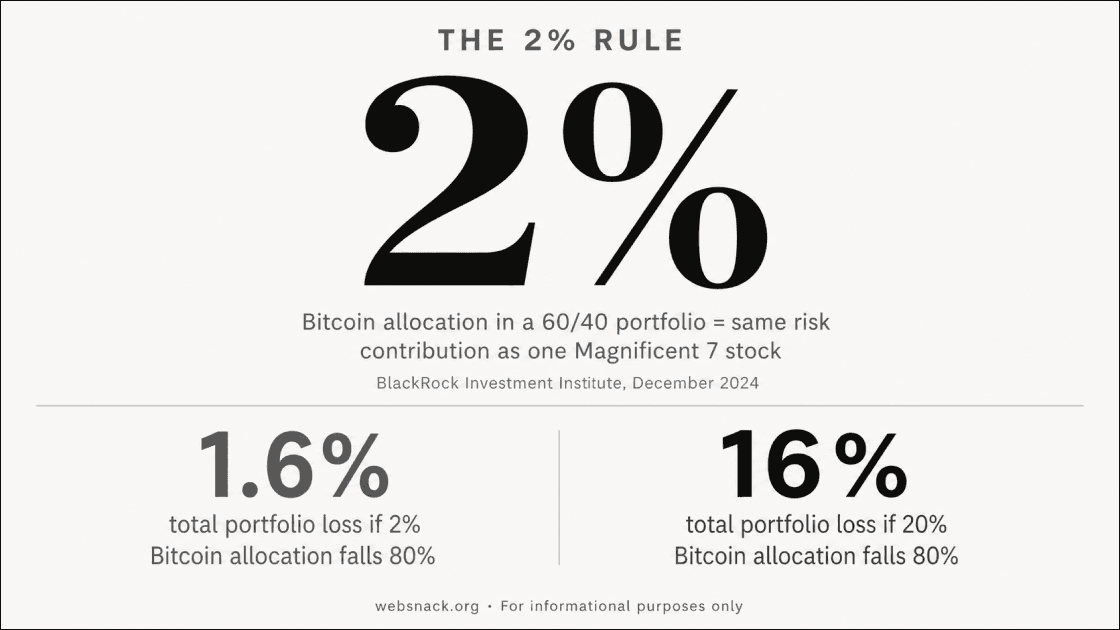
BlackRock published a specific framework in December 2024. In a traditional 60/40 portfolio, a 1% to 2% allocation to Bitcoin generates the same risk contribution as a single Magnificent 7 stock. Above 2%, Bitcoin's share of total portfolio risk rises sharply. Below 1%, the position is too small to move returns.
"A 1-2% allocation to bitcoin is a reasonable range for a multi-asset portfolio if investors believe it will become more widely adopted and can bear the risk of potentially rapid price plunges." - Paul Henderson, Robert Mitchnick, Samara Cohen, Vivek Paul, BlackRock Investment Institute, December 2024
IBIT trades on NASDAQ; FBTC trades on Cboe BZX Exchange. Both carry a 0.25% expense ratio and are available through standard brokerage accounts and IRAs. No crypto exchange, no private keys, no custody decisions. Buying either is operationally identical to buying any equity ETF.
The harder question is drawdown tolerance. Since 2014, Bitcoin has experienced four drawdowns exceeding 50%. The three largest averaged roughly 80% peak-to-trough and took nearly three years each to recover.
The 2021 to 2022 cycle saw Bitcoin fall 77.6%, from $69,044 to $15,476, over 376 days. It took approximately 730 days to reach new highs.
An investor who allocates 2% to Bitcoin and watches it fall 80% loses 1.6% of their total portfolio. That is manageable. An investor who allocates 20% faces a 16% portfolio loss from the crypto position alone, before factoring in what equities do in the same period. Position sizing is the decision. Not entry price.
Dollar-cost averaging (regular fixed-amount purchases on a set schedule, regardless of price) reduces the timing risk. The investors who came out ahead in Bitcoin's recovery cycles were mostly those who either held without watching or kept buying through the drawdown.
What to Watch Before and After You Allocate
Bitcoin's current market position matters for timing. It hit $126,296 on October 6, 2025, its most recent all-time high, then fell roughly 46.7% to around $67,550 by mid-February 2026. Whether this is a buying window or the start of a longer down cycle is the key binary for 2026.
Three specific signals are worth tracking.
Watch Bitcoin ETF flows first. Sustained weekly net inflows into IBIT and FBTC signal institutional demand is holding. S&P Global noted outflows above $1.2 billion in April and early May 2025, a period that preceded the current correction. That data is publicly available weekly.
Watch the US Clarity Act. As of early 2026, the Senate has not passed comprehensive spot-market crypto regulation. Passage unlocks the institutional capital sitting on the sidelines: pension funds, insurance companies, and bank trust departments that require explicit regulatory permission before allocating.
Watch Ethereum separately from Bitcoin. BlackRock launched ETHB, its staked Ethereum ETF, in March 2026, the first regulated ETF to offer staking yield through a standard brokerage account. BlackRock's non-staking version, ETHA, holds $6.6 billion in AUM. If ETHB attracts meaningful inflows, the risk/return case for ETH changes in ways that don't apply to Bitcoin.
Bitcoin hit a 46% correction from its 2025 high. The allocation framework is the same whether this is the bottom or the start of a bear market. Subscribe to Web Snack weekly.
This article is for informational purposes only and does not constitute investment advice. Always conduct your own research before making any financial decisions.
Like this story? There's more tomorrow
Join Web Snack – no fluff, just value