Bitcoin's 2024 halving delivered its weakest post-halving rally on record. Here is what the cycle data says about the 2028 setup, 695 days out.
Don't scroll Twitter for crypto news
One email. Five minutes. Everything that matters today
The next bitcoin halving 2028 arrives around April 12, roughly 695 days from now, when the block reward drops from 3.125 to 1.5625 BTC. Two years after the April 2024 event, Bitcoin trades near $77,000, down 39% from its October 2025 all-time high of $126,198. The data from this cycle changes what most investors think they know about how halvings work.
Two years of post-2024 halving data changed the playbook. Read the full breakdown before the next event arrives.
Why the 2024 Halving Produced Bitcoin's Weakest Post-Halving Rally
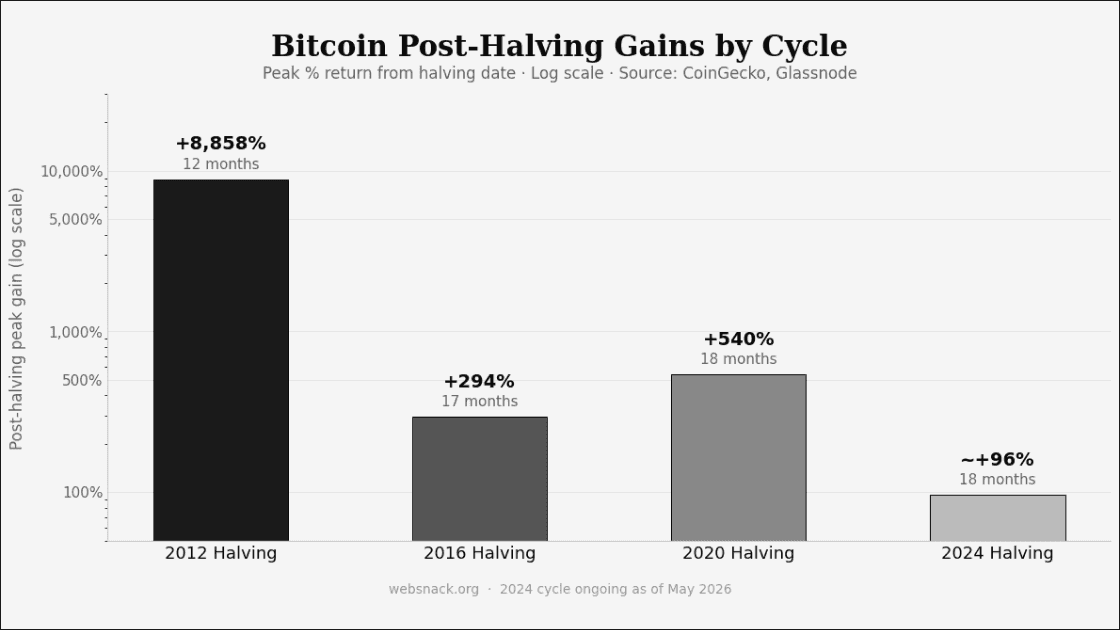
After the April 2024 halving, Bitcoin gained approximately 96% from the halving-day price of $64,262 to its October 2025 peak of $126,198. Every previous cycle delivered larger percentage returns: 8,858% in the 12 months after the November 2012 event, 294% after July 2016, 540% after May 2020. The gap is real. The cause is not what most post-mortems argue.
Bitcoin hit $73,016 in March 2024, a new all-time high six weeks before the halving. No previous cycle had ever set a record before the supply cut. By the time miners' reward halved on April 20, institutional and retail buyers had already absorbed most of the expected scarcity signal. The post-halving move started from a weaker baseline than any of the three cycles before it, because demand front-ran the event rather than arriving after it.
The macro context made things worse. Kaiko Research tracked the Economic Policy Uncertainty Index in the six months following each halving: 107 in 2012, 109 in 2016, 186 in 2020, 317 in 2024. Bitcoin still hit a new all-time high. The four-year schedule held. The magnitude compressed under the worst macro backdrop the asset had faced in any post-halving window.
Before spot ETFs, the playbook depended on retail capital discovering Bitcoin in waves, months after the event. BlackRock's IBIT attracted $37 billion in inflows in 2024 alone. By October 2025 it held over 800,000 BTC, roughly 3.8% of total supply. Institutional demand absorbed the post-halving supply reduction before most retail participants had registered the cycle was underway.
How the 2028 Halving Changes Bitcoin's Supply Math
The fifth Bitcoin halving, projected around April 12, 2028, at block 1,050,000, cuts the reward from 3.125 BTC to 1.5625 BTC. Daily new Bitcoin issuance falls from 450 BTC to 225 BTC. That is the smallest absolute supply reduction in the history of the protocol.
The 2024 halving cut Bitcoin's annual inflation rate from 1.7% to 0.85%. The 2028 event pushes it below 0.4%. Nearly 94% of all 21 million Bitcoin has been mined by May 2026. By the time the next halving fires, that rises to over 96.8%. The supply-shock argument gets mathematically thinner with each cycle. That is not a flaw in the design. It is the design.
Transaction fees are supposed to fill the gap. During the Runes protocol launch in April 2024, some blocks briefly earned over 10 BTC in fees, far above the 3.125 BTC subsidy. That was a one-off protocol event. Through most of 2025, fees averaged 0.018 BTC per block, about 0.6% of total block rewards. For the network's long-term security budget to hold after 2028, on-chain demand for block space needs to grow well beyond what the current market produces.
What the Cycle Comparison Table Actually Shows
Halving | Date | Reward | Post-Halving Peak Gain |
|---|---|---|---|
1st | Nov 28, 2012 | 25 BTC | +8,858% (12 months) |
2nd | Jul 9, 2016 | 12.5 BTC | +294% (17 months) |
3rd | May 11, 2020 | 6.25 BTC | +540% (18 months) |
4th | Apr 20, 2024 | 3.125 BTC | ~+96% (18 months) |
The percentage column is declining. The timing column is not. The 2016 and 2020 cycles peaked 17 to 18 months post-halving. The 2024 cycle peaked at almost exactly 18 months, on October 6, 2025. The schedule held. What changed is how far the price traveled on the way to a new all-time high.
Bitcoin's 60-day realized volatility dropped from over 200% in 2012 to around 50% today. US spot Bitcoin ETFs pulled in $61.5 billion in cumulative net inflows by October 2025. "IBIT is the fastest-growing ETF in the history of ETFs," BlackRock CEO Larry Fink said in March 2024. Institutional capital buys consistently and sells less impulsively. It also removes the leverage-driven blow-off tops that produced triple-digit gains in earlier cycles.
The diminishing-returns frame can mislead here. A 96% gain from a $64,000 base delivers more absolute dollars per coin than a 540% gain from $8,700 in 2020. The base matters. Investors who bought on halving day 2024 are up roughly 20% at today's ~$77,000 price, not because the cycle failed but because the post-ATH drawdown is 39% deep and ongoing. The question for 2028 is not whether percentage gains will rival 2012. They won't. The question is whether the 18 months after April 2028 produce a new all-time high from wherever the market sits at that point.
The Mining Squeeze That Defines Mid-Cycle 2026
Bitcoin miners face the tightest margin environment since the April 2024 halving. Hash price, the daily revenue per unit of computing power, fell from $63 per PH/s/day in July 2025 to $28 to 30 per PH/s/day by March 2026, according to CoinShares data. The weighted average cash cost to mine one Bitcoin among publicly listed miners reached $79,995 in Q4 2025, almost exactly equal to Bitcoin's spot price at the time.
Three forces converged. The halving cut block subsidy revenue 50% in April 2024. The global hashrate climbed from roughly 700 EH/s at the start of 2024 to over 1,020 EH/s by late 2025, compressing each miner's share of the reward pool. Fees averaged 0.018 BTC per block and contributed under 1% of total block rewards. The breakeven electricity cost for Antminer S19 XP hardware fell from $0.12 per kilowatt-hour in December 2024 to $0.077 by December 2025. Miners running above that threshold were cash-flow negative.

The industry did not exit. Marathon Digital acquired a 64% stake in Exaion for $174.5 million in February 2026 to expand into AI and high-performance computing hosting. Core Scientific converted substantial capacity to AI workloads. The largest mining companies are becoming energy and compute infrastructure businesses that mine Bitcoin on the side. That shift changes the sector's economic profile heading into 2028: the next halving cuts the subsidy to 1.5625 BTC, and diversified revenue is the only realistic buffer.
What the 2028 Halving Setup Looks Like From Here
US spot Bitcoin ETFs held approximately 1.3 million BTC by April 2026, about 6% of all coins ever mined. Strategy held 818,000 BTC as of April 2026, representing over 3.9% of total supply. Together, those two categories have locked roughly 10% of Bitcoin's entire supply into long-duration positions that don't respond to short-term price moves. The 2028 halving fires into a market where a tenth of the asset base is effectively inert.
Grayscale's 2026 Digital Asset Outlook argued that systematic institutional capital flows have replaced the retail halving narrative as Bitcoin's primary price driver. The case has merit. The 2028 halving will produce 225 BTC per day in new supply against a market where major ETFs routinely absorb more than that in a single day of inflows. The absolute supply shock is smaller with each event. The institutional demand base is larger. Whether those forces offset each other or one dominates is the central question for the next cycle.
The Fed ended quantitative tightening in December 2025, but that is not the same as quantitative easing. Bitcoin's correlation with global M2 money supply is documented, and recoveries from drawdowns track more cleanly with expanding liquidity than with the halving schedule. A genuine liquidity expansion is the macro catalyst the 2024 cycle lacked. Watch weekly US spot ETF inflows: a sustained return above $1 billion per week signals renewed institutional demand rather than the structural outflows recorded in Q4 2025. And watch on-chain fees: if average fees per block rise sustainably above 0.15 BTC without a protocol spike, the network's security model gains credibility before the 2028 reward cut arrives.
Watch the Fed, the ETF flows, and the fee data. Those three numbers tell more about 2028 than any price prediction.
This article is for informational purposes only and does not constitute investment advice. Always conduct your own research before making any financial decisions.
Like this story? There's more tomorrow
Join Web Snack – no fluff, just value